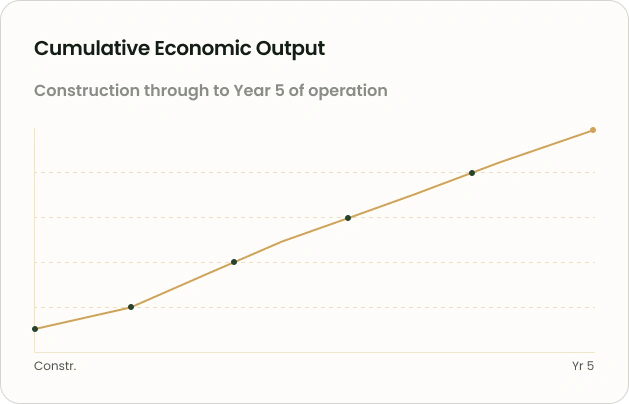
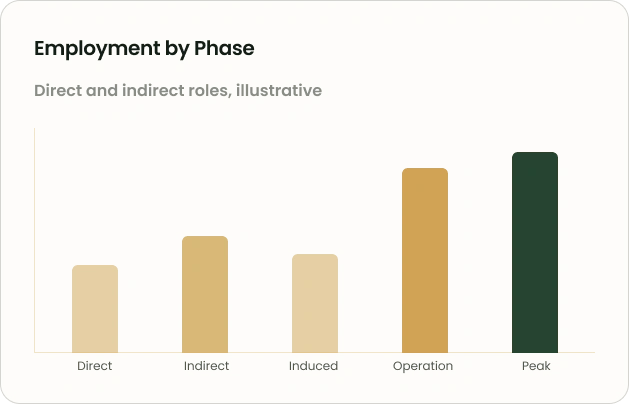
Economic benefit is part of the public-interest test. Evidencing jobs, output and wider economic contribution shifts the planning conversation from cost to benefit.
Jobs → Output → Economic Contribution → Public Benefit
Methodology
Our approach
01
Construction-Phase Employment
Direct and indirect jobs generated during the build.
02
Operational-Phase Employment
Clear, legible pathways and thresholds that guide movement and make unauthorised access obvious.
03
Economic Output
Value-add contribution across construction and operation
04
Input-Output Modelling
Flow-on effects across the wider regional economy.
05
Cost-Benefit Framing
Positioning the numbers within the planning balance.
Methodology
Our approach
A preview of how findings are presented — clear, editorial data visualisation built for lodgement and stakeholder communication.
DELIVERABLES
What's included
A lodgement-ready evidence base that gives the applicant a stronger economic narrative.
Economic impact assessment report
A full report prepared for lodgement with the consent authority.
Headline benefit figures
Clear, citable figures for the applicant's narrative and stakeholder communications.
Response-to-submissions support
Assistance addressing economic questions raised during exhibition or agency review.
APPLICABILITY
When it's required
01
SSDAs & Larger DAs
Projects where economic benefit forms part of the merit assessment.
02
Mixed-Use & Public-Domain Schemes
Developments where job creation is a central part of the case.
03
SSDAs
Projects touching an existing retail or commercial hierarchy.
04
EIS Scoping
Early-stage scoping of the economic considerations for an EIS.
Who we work with
Who we work with
We engage on behalf of Tier-1 property developers, public infrastructure agencies, state and local government, energy and resources proponents, and urban planning practices.
Our team draws on senior experience inside government and senior roles in social planning and communications — so we understand both the regulator’s expectations and the proponent’s commercial reality.
Frequently asked
Frequently asked questions
Don’t see your question? Get in touch and we’ll
respond within one business day.
When in the project lifecycle should we start community engagement?
As early as possible. Early-stage engagement — before a design is locked in — typically
delivers the highest return on investment, because community input can still
meaningfully shape the project. Late-stage engagement conducted only to satisfy
compliance requirements rarely builds genuine support and often triggers stronger
opposition.
Do you handle state significant and major project engagement?
Yes. Many of our energy engagements continue beyond the approval milestone into the operational phase — particularly for renewable energy and transmission assets where community relations need to be maintained over the life of the asset.
How do you measure community sentiment fairly?
Yes. We work across the energy and resources sector including traditional and transitional energy. We accept the usual conflict-checking obligations before taking on new work.
Can you manage organised opposition campaigns?
Yes. We are frequently engaged this way for state-significant infrastructure and resources projects, particularly where an environmental consultant is leading the EIS but needs a specialist social and engagement workstream.
How much does community engagement cost?
Yes. Many energy and resources projects sit in regional or remote contexts. We adapt our engagement methods — in-person presence, intercept work, phone and online research — to the specific community profile.
Ready to talk?
Whether you’re scoping a new project or refining an
existing program, we’d welcome a conversation.